
Direkt zum Inhalt
Eye Icon

Bitte Lieferland und Währung prüfen (Weltkugel-Icon klicken). Wechsel dauert etwa 10 Sekunden.

The eyewash with the certificates of analysis

In general, you should not overestimate the importance of certificates of analysis. It remains a question of trust, because even if someone were to show you a certificate of analysis, it would not be certain that the glass delivered to you contained the substance analyzed... :-(

If you want to be absolutely sure, the only option is to have the substance delivered analyzed yourself. It could be worth it if you order a sufficiently large quantity, because then the costs for the analysis (converted to the price per gram) are no longer so important.

The results of chemical analyzes are often not easy to understand for non-experts. The nominal degree of purity is usually given far too much importance because this number is misleading for at least two reasons:

1. Accuracy of the analysis method (+/- 2%)

The industry standard for the analysis of NMN and most other substances we sell is HPLC.
This analysis result is for most Probably 'disturbing' to customers, because the reported purity level of the tested NMN was well over 100%.

We have tried to formulate an explanation for this analysis result. on the Internet that an educated layperson without any special knowledge of (bio-)chemistry can understand, but unfortunately we were not able to do that. This is due to the complexity of the analytical method used (HPLC). 

The laboratory in the USA that carried out this analysis for us (Intertek) itself wrote about this result:

"Hello Peter,
 I am not sure how to help here, They are technically correct. The only way to determine a 'true value' is through statistical analysis of multiple chemical analysis. If we allow for a variance +2% then a variance -2% is equally as likely. The only thing I can offer is that this is an industry accepted practice and that there is no better way to achieve results on a single analysis. We stand by our analysis and, since we are audited by the FDA, we are following all required measures of quality required from an ISO certified, GMP facility. 

Stay Healthy and Best Regards
Noah Morgan
Key Account Manager"

What does that mean?Well: First of all, this means that a single analysis (it costs about $150) only has an accuracy of +/- 2%! If you wanted greater accuracy, you would have to run multiple (numerous) analyzes (at $150 each) and then average them. So if one of our competitors presents a (single) certificate with a purity of 99.9%, the actual purity may be (only) 97.9%!

In our case, however, it means something very special and very pleasing for us: If we assume a measurement uncertainty of +/- 2%, then the degree of purity is 'ours' NMN in the worst case at least 99.8%! (Our supplier's Certificate of Analysis indicates a purity of 99.9%.) This is therefore extremely pure NMN.

2. The degree of purity says practically nothing about the quality

(See also Notes on the required level of purity of NMN)

Bild wird geladen:

We are often asked: "If the analyzed purity of NMN or NAD* is 97.5%, what is the remaining 2.5%?"
The answer: Water of crystallization You could further increase the level of purity simply by trying to get rid of the crystal water, but that would only make the product unnecessarily more expensive without any increase in quality.

What is really important is not so much the degree of purity, but rather the result of the microbiological analysis and the analysis of heavy metal contamination.

What do you need to know?

In the current analysis report shown here about the NAD+ we sell, you can see information in the section about the microbiological analysis < 10 and < 100.
These are guideline values that should be adhered to (or warning values that are not & uuml; may be exceeded).
The unit of measurement for these guideline or warning values is CFU/g

When analyzing for heavy metals, particularly strict guidelines apply; ideally it says "n.n." for 'below the detection limit'.

El colirio con los certificados de análisis.

In general, you should not overestimate the importance of certificates of analysis. It remains a question of trust, because even if someone were to show you a certificate of analysis, it would not be certain that the glass delivered to you contained the substance analyzed... :-(

If you want to be absolutely sure, the only option is to have the substance delivered analyzed yourself. It could be worth it if you order a sufficiently large quantity, because then the costs for the analysis (converted to the price per gram) are no longer so important.

The results of chemical analyzes are often not easy to understand for non-experts. The nominal degree of purity is usually given far too much importance because this number is misleading for at least two reasons:

1. Accuracy of the analysis method (+/- 2%)

The industry standard for the analysis of NMN and most other substances we sell is HPLC.
This analysis result is for most Probably 'disturbing' to customers, because the reported purity level of the tested NMN was well over 100%.

We have tried to formulate an explanation for this analysis result. on the Internet that an educated layperson without any special knowledge of (bio-)chemistry can understand, but unfortunately we were not able to do that. This is due to the complexity of the analytical method used (HPLC). 

The laboratory in the USA that carried out this analysis for us (Intertek) itself wrote about this result:

"Hello Peter,
 I am not sure how to help here, They are technically correct. The only way to determine a 'true value' is through statistical analysis of multiple chemical analysis. If we allow for a variance +2% then a variance -2% is equally as likely. The only thing I can offer is that this is an industry accepted practice and that there is no better way to achieve results on a single analysis. We stand by our analysis and, since we are audited by the FDA, we are following all required measures of quality required from an ISO certified, GMP facility. 

Stay Healthy and Best Regards
Noah Morgan
Key Account Manager"

What does that mean?Well: First of all, this means that a single analysis (it costs about $150) only has an accuracy of +/- 2%! If you wanted greater accuracy, you would have to run multiple (numerous) analyzes (at $150 each) and then average them. So if one of our competitors presents a (single) certificate with a purity of 99.9%, the actual purity may be (only) 97.9%!

In our case, however, it means something very special and very pleasing for us: If we assume a measurement uncertainty of +/- 2%, then the degree of purity is 'ours' NMN in the worst case at least 99.8%! (Our supplier's Certificate of Analysis indicates a purity of 99.9%.) This is therefore extremely pure NMN.

2. The degree of purity says practically nothing about the quality

(See also Notes on the required level of purity of NMN)

Bild wird geladen:

We are often asked: "If the analyzed purity of NMN or NAD* is 97.5%, what is the remaining 2.5%?"
The answer: Water of crystallization You could further increase the level of purity simply by trying to get rid of the crystal water, but that would only make the product unnecessarily more expensive without any increase in quality.

What is really important is not so much the degree of purity, but rather the result of the microbiological analysis and the analysis of heavy metal contamination.

What do you need to know?

In the current analysis report shown here about the NAD+ we sell, you can see information in the section about the microbiological analysis < 10 and < 100.
These are guideline values that should be adhered to (or warning values that are not & uuml; may be exceeded).
The unit of measurement for these guideline or warning values is CFU/g

When analyzing for heavy metals, particularly strict guidelines apply; ideally it says "n.n." for 'below the detection limit'.

Le collyre avec les certificats d'analyse

In general, you should not overestimate the importance of certificates of analysis. It remains a question of trust, because even if someone were to show you a certificate of analysis, it would not be certain that the glass delivered to you contained the substance analyzed... :-(

If you want to be absolutely sure, the only option is to have the substance delivered analyzed yourself. It could be worth it if you order a sufficiently large quantity, because then the costs for the analysis (converted to the price per gram) are no longer so important.

The results of chemical analyzes are often not easy to understand for non-experts. The nominal degree of purity is usually given far too much importance because this number is misleading for at least two reasons:

1. Accuracy of the analysis method (+/- 2%)

The industry standard for the analysis of NMN and most other substances we sell is HPLC.
This analysis result is for most Probably 'disturbing' to customers, because the reported purity level of the tested NMN was well over 100%.

We have tried to formulate an explanation for this analysis result. on the Internet that an educated layperson without any special knowledge of (bio-)chemistry can understand, but unfortunately we were not able to do that. This is due to the complexity of the analytical method used (HPLC). 

The laboratory in the USA that carried out this analysis for us (Intertek) itself wrote about this result:

"Hello Peter,
 I am not sure how to help here, They are technically correct. The only way to determine a 'true value' is through statistical analysis of multiple chemical analysis. If we allow for a variance +2% then a variance -2% is equally as likely. The only thing I can offer is that this is an industry accepted practice and that there is no better way to achieve results on a single analysis. We stand by our analysis and, since we are audited by the FDA, we are following all required measures of quality required from an ISO certified, GMP facility. 

Stay Healthy and Best Regards
Noah Morgan
Key Account Manager"

What does that mean?Well: First of all, this means that a single analysis (it costs about $150) only has an accuracy of +/- 2%! If you wanted greater accuracy, you would have to run multiple (numerous) analyzes (at $150 each) and then average them. So if one of our competitors presents a (single) certificate with a purity of 99.9%, the actual purity may be (only) 97.9%!

In our case, however, it means something very special and very pleasing for us: If we assume a measurement uncertainty of +/- 2%, then the degree of purity is 'ours' NMN in the worst case at least 99.8%! (Our supplier's Certificate of Analysis indicates a purity of 99.9%.) This is therefore extremely pure NMN.

2. The degree of purity says practically nothing about the quality

(See also Notes on the required level of purity of NMN)

Bild wird geladen:

We are often asked: "If the analyzed purity of NMN or NAD* is 97.5%, what is the remaining 2.5%?"
The answer: Water of crystallization You could further increase the level of purity simply by trying to get rid of the crystal water, but that would only make the product unnecessarily more expensive without any increase in quality.

What is really important is not so much the degree of purity, but rather the result of the microbiological analysis and the analysis of heavy metal contamination.

What do you need to know?

In the current analysis report shown here about the NAD+ we sell, you can see information in the section about the microbiological analysis < 10 and < 100.
These are guideline values that should be adhered to (or warning values that are not & uuml; may be exceeded).
The unit of measurement for these guideline or warning values is CFU/g

When analyzing for heavy metals, particularly strict guidelines apply; ideally it says "n.n." for 'below the detection limit'.

Il collirio con i certificati di analisi

In general, you should not overestimate the importance of certificates of analysis. It remains a question of trust, because even if someone were to show you a certificate of analysis, it would not be certain that the glass delivered to you contained the substance analyzed... :-(

If you want to be absolutely sure, the only option is to have the substance delivered analyzed yourself. It could be worth it if you order a sufficiently large quantity, because then the costs for the analysis (converted to the price per gram) are no longer so important.

The results of chemical analyzes are often not easy to understand for non-experts. The nominal degree of purity is usually given far too much importance because this number is misleading for at least two reasons:

1. Accuracy of the analysis method (+/- 2%)

The industry standard for the analysis of NMN and most other substances we sell is HPLC.
This analysis result is for most Probably 'disturbing' to customers, because the reported purity level of the tested NMN was well over 100%.

We have tried to formulate an explanation for this analysis result. on the Internet that an educated layperson without any special knowledge of (bio-)chemistry can understand, but unfortunately we were not able to do that. This is due to the complexity of the analytical method used (HPLC). 

The laboratory in the USA that carried out this analysis for us (Intertek) itself wrote about this result:

"Hello Peter,
 I am not sure how to help here, They are technically correct. The only way to determine a 'true value' is through statistical analysis of multiple chemical analysis. If we allow for a variance +2% then a variance -2% is equally as likely. The only thing I can offer is that this is an industry accepted practice and that there is no better way to achieve results on a single analysis. We stand by our analysis and, since we are audited by the FDA, we are following all required measures of quality required from an ISO certified, GMP facility. 

Stay Healthy and Best Regards
Noah Morgan
Key Account Manager"

What does that mean?Well: First of all, this means that a single analysis (it costs about $150) only has an accuracy of +/- 2%! If you wanted greater accuracy, you would have to run multiple (numerous) analyzes (at $150 each) and then average them. So if one of our competitors presents a (single) certificate with a purity of 99.9%, the actual purity may be (only) 97.9%!

In our case, however, it means something very special and very pleasing for us: If we assume a measurement uncertainty of +/- 2%, then the degree of purity is 'ours' NMN in the worst case at least 99.8%! (Our supplier's Certificate of Analysis indicates a purity of 99.9%.) This is therefore extremely pure NMN.

2. The degree of purity says practically nothing about the quality

(See also Notes on the required level of purity of NMN)

Bild wird geladen:

We are often asked: "If the analyzed purity of NMN or NAD* is 97.5%, what is the remaining 2.5%?"
The answer: Water of crystallization You could further increase the level of purity simply by trying to get rid of the crystal water, but that would only make the product unnecessarily more expensive without any increase in quality.

What is really important is not so much the degree of purity, but rather the result of the microbiological analysis and the analysis of heavy metal contamination.

What do you need to know?

In the current analysis report shown here about the NAD+ we sell, you can see information in the section about the microbiological analysis < 10 and < 100.
These are guideline values that should be adhered to (or warning values that are not & uuml; may be exceeded).
The unit of measurement for these guideline or warning values is CFU/g

When analyzing for heavy metals, particularly strict guidelines apply; ideally it says "n.n." for 'below the detection limit'.

O colírio com os certificados de análise

In general, you should not overestimate the importance of certificates of analysis. It remains a question of trust, because even if someone were to show you a certificate of analysis, it would not be certain that the glass delivered to you contained the substance analyzed... :-(

If you want to be absolutely sure, the only option is to have the substance delivered analyzed yourself. It could be worth it if you order a sufficiently large quantity, because then the costs for the analysis (converted to the price per gram) are no longer so important.

The results of chemical analyzes are often not easy to understand for non-experts. The nominal degree of purity is usually given far too much importance because this number is misleading for at least two reasons:

1. Accuracy of the analysis method (+/- 2%)

The industry standard for the analysis of NMN and most other substances we sell is HPLC.
This analysis result is for most Probably 'disturbing' to customers, because the reported purity level of the tested NMN was well over 100%.

We have tried to formulate an explanation for this analysis result. on the Internet that an educated layperson without any special knowledge of (bio-)chemistry can understand, but unfortunately we were not able to do that. This is due to the complexity of the analytical method used (HPLC). 

The laboratory in the USA that carried out this analysis for us (Intertek) itself wrote about this result:

"Hello Peter,
 I am not sure how to help here, They are technically correct. The only way to determine a 'true value' is through statistical analysis of multiple chemical analysis. If we allow for a variance +2% then a variance -2% is equally as likely. The only thing I can offer is that this is an industry accepted practice and that there is no better way to achieve results on a single analysis. We stand by our analysis and, since we are audited by the FDA, we are following all required measures of quality required from an ISO certified, GMP facility. 

Stay Healthy and Best Regards
Noah Morgan
Key Account Manager"

What does that mean?Well: First of all, this means that a single analysis (it costs about $150) only has an accuracy of +/- 2%! If you wanted greater accuracy, you would have to run multiple (numerous) analyzes (at $150 each) and then average them. So if one of our competitors presents a (single) certificate with a purity of 99.9%, the actual purity may be (only) 97.9%!

In our case, however, it means something very special and very pleasing for us: If we assume a measurement uncertainty of +/- 2%, then the degree of purity is 'ours' NMN in the worst case at least 99.8%! (Our supplier's Certificate of Analysis indicates a purity of 99.9%.) This is therefore extremely pure NMN.

2. The degree of purity says practically nothing about the quality

(See also Notes on the required level of purity of NMN)

Bild wird geladen:

We are often asked: "If the analyzed purity of NMN or NAD* is 97.5%, what is the remaining 2.5%?"
The answer: Water of crystallization You could further increase the level of purity simply by trying to get rid of the crystal water, but that would only make the product unnecessarily more expensive without any increase in quality.

What is really important is not so much the degree of purity, but rather the result of the microbiological analysis and the analysis of heavy metal contamination.

What do you need to know?

In the current analysis report shown here about the NAD+ we sell, you can see information in the section about the microbiological analysis < 10 and < 100.
These are guideline values that should be adhered to (or warning values that are not & uuml; may be exceeded).
The unit of measurement for these guideline or warning values is CFU/g

When analyzing for heavy metals, particularly strict guidelines apply; ideally it says "n.n." for 'below the detection limit'.

Unser Qualitätsversprechen

Im Longevity-Bereich gibt es viel Marketing – und leider auch viel Unschärfe. Wir setzen deshalb nicht auf große Worte, sondern auf ein Prinzip: Qualität muss nachvollziehbar sein.

Zertifikate sind gut – aber nicht ausreichend

Zertifikate (z. B. ISO, GMP) können ein hilfreicher Baustein sein. Entscheidend ist jedoch, was im konkreten Produkt und in der konkreten Charge tatsächlich vorliegt. Deshalb stützen wir uns nicht ausschließlich auf Dokumente, sondern auf dokumentierte Qualitätsprozesse und – wo sinnvoll – unabhängige Analytik.

Worauf wir achten: Identität, Reinheit, Sicherheit

Je nach Produkt und Risikoprofil achten wir besonders auf:

• Identität: Ist der Rohstoff wirklich das, was er sein soll?

• Reinheit: Liegt der Stoff innerhalb der Spezifikation?

• Sicherheit: z. B. Schwermetalle, Mikrobiologie (wo relevant)

Nicht jedes Produkt erfordert dieselben Prüfungen. Wir arbeiten daher risikobasiert: Je sensibler ein Rohstoff, desto strenger der Prüf- und Dokumentationsansatz.

Unabhängige Analysen – dort, wo sie sinnvoll sind

Wo es angebracht ist, nutzen wir unabhängige Laboranalysen – insbesondere bei neuen Rohstoffen, neuen Lieferwegen oder bei Produkten mit erhöhtem Prüfbedarf. Das Ziel ist nicht „Analyse um jeden Preis“, sondern ein verlässliches Verhältnis aus Sicherheit, Aussagekraft und Aufwand.

Chargenlogik & Rückverfolgbarkeit

Qualität muss wiederholbar sein. Deshalb arbeiten wir mit Chargenlogik und dokumentieren so, dass Rückverfolgbarkeit möglich ist.

Transparenz: Was wir geben können – und was nicht

Was wir gern geben: verfügbare Qualitätsinformationen zu einem konkreten Produkt/Charge (wo vorhanden).

Was wir nicht veröffentlichen: Lieferantenlisten. Das schützt faire Zusammenarbeit und verhindert, dass Qualität auf reine „Herkunfts-Rhetorik“ reduziert wird.

Wenn Sie Dokumente zu einem Produkt wünschen, senden Sie uns bitte den Produktnamen und – falls vorhanden – die Chargenangabe. Wir prüfen dann, welche Unterlagen verfügbar sind.

 Realistische Kommunikation statt Heilsversprechen

Wir versprechen keine Wunder. Wir setzen auf nachvollziehbare Qualität, klare Anwendungshinweise und ehrliche Grenzen. Unsere Inhalte dienen der Information und ersetzen keine medizinische Beratung.

Hinweis

Nahrungsergänzungsmittel sind kein Ersatz für eine ausgewogene Ernährung und eine gesunde Lebensweise. Bei Erkrankungen oder Medikation empfehlen wir Rücksprache mit einer medizinischen Fachperson.

Ein Kommentar von Dr. Peter Niehenke (Leiter der Abteilung 'Forschung und Produktentwicklung): Die Augenwischerei mit den Analysezertifikaten

Analysenzertifikate (COA) können hilfreich sein – sie sind aber kein Ersatz für einen verlässlichen Qualitätsprozess. Ein COA bezieht sich immer auf eine konkret analysierte Probe. Deshalb ist entscheidend, wie sauber Dokumentation, Chargenlogik und Qualitätskontrollen insgesamt umgesetzt sind.

Wenn Sie sich für Analysen interessieren: Werte sind für Nicht-Fachleute oft schwer einzuordnen. Besonders wichtig ist die Messunsicherheit des Verfahrens. Bei der Reinheitsbestimmung (z. B. mittels HPLC) sind Abweichungen durch Messunsicherheit, Referenzstandards und Probenhandling möglich. In seltenen Fällen können dadurch Werte leicht über 100 % erscheinen – das bedeutet nicht „mehr als 100 % Substanz“, sondern ist ein Effekt der Messung und spricht in der Praxis für einen sehr hohen Reinheitsgrad..

2. Der Reinheitsgrad sagt wenig über die Qualität

(Siehe auch Anmerkungen zum notwendigen Reinheitsgrad von NMN)
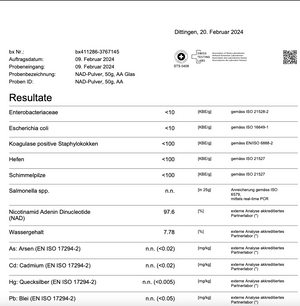
Bild wird geladen:

Wir werden häufig gefragt: "Wenn der analysierte Reinheitsgrad von NMN oder NAD* bei 97,5% liegt, was sind denn dann die verbleibenden 2,5%?"
Die Antwort: Kristallwasser

Man könnte den Reinheitsgrad also einfach dadurch weiter steigern, dass man versucht, sich des Kristallwassers zu entledigen, aber das würde das Produkt ohne jeden Qualitätsgewinn nur unnötig verteuern. 

Wirklich bedeutsam ist daher nicht so sehr der Reinheitsgrad, sondern das Ergebnis der mikrobiologischen Analyse und der Analyse der Schwermetallbelastung.

Was muss man dazu wissen?

In dem hier abgebildeten aktuellen Analysebericht über das von uns vertriebene NAD+  sehen Sie im Abschnitt über die mikrobiologische Analayse Angaben < 10 und < 100.
Dabei handelt es sich um Richtwerte, die eingehalten werden sollten (oder Warnwerte, die nicht überschritten werden dürfen).
Die Maßeinheit für diese Richt- bzw. Warnwerte ist KbE/g

Bei der Analyse auf Schwermetalle gelten besonders strenge Richtwerte, idealerweise steht dort "n.n." für 'unterhalb der Nachweisgrenze'.

Back to top